

Acer Predator X35 Review
Recently we reviewed the Asus ROG Swift PG35VQ, a monstrous 3440 x 1440 ultrawide with a massive 200 Hz refresh rate and proper HDR back up. We weren't afraid to call information technology the best monitor nosotros have ever tested. Well, equally many cracking monitor fans would know, Acer has their ain version of this display, the Acer Predator X35, and today nosotros'll be putting it head to head against the PG35VQ to encounter how it stacks upward.
As expected the Predator X35 packs the same specs as the PG35VQ because information technology uses the same panel. It's a 35-inch 3440 x 1440 VA console with up to a 200 Hz refresh charge per unit, 1800R curvature and G-Sync Ultimate support.

It'southward a true HDR monitor every bit well, with DisplayHDR 1000 certification and a 512-zone full array local dimming backlight. Pricing is likewise similar: both are expected to toll around $two,500 when they go on sale since neither is widely available nonetheless.
With that sort of cost tag, this monitor isn't going to exist for everyone. In fact at that place are places like in Australia where it costs considerably more than, with an MSRP of $four,000 this thing costs more than a high-cease LG OLED Boob tube.

Without doubt manufacturers are setting a high bar for true HDR in a monitor form factor. Given y'all'll need an RTX 2080 Ti to make full apply of the loftier refresh capabilities on a panel like this, we imagine this is the sort of equipment only high rollers volition terminate upwards buying. But hopefully what nosotros go through today will show where monitors are headed in the next few years.
For the blueprint, both Acer and Asus are adequately heavy on the gamer way. If you've read any of our by reviews you'll know nosotros favor more subtle looks, merely at that place volition be some people that are more bully on huge RGB zones that you can't even encounter from the front. Nosotros have a slight preference for Acer's X35 design over the PG35VQ but they are not overly different: both apply black plastic, both have like bezels, both have metal stands, both pack height, tilt and swivel aligning; both are as well made.

The array of ports is typical for a Chiliad-Sync monitor: a single HDMI and single DisplayPort input, plus some USB ports. That's information technology. There are no audio jacks, although the X35 packs some lousy born speakers.
The on screen brandish is controlled through a directional toggle. It besides has the standard range of Acer features, including cheat crosshairs, a low blueish lite mode, and a dark boosting mode. Like a few other monitors we've reviewed recently, there is no backlight strobing mode for added clarity, presumably that was too difficult to get working with an FALD backlight.

One glaring issue with the X35 is the active cooling fan. This has been a feature of all Thou-Sync Ultimate HDR monitors and then far, to varying degrees of success. While the fan isn't very noticeable in the Asus PG35VQ, for some reason Acer has decided that pulsing the fan betwixt a slow and fast speed is the all-time grade of action. This means that from time to time, the fan will of a sudden engage; in a placidity room, it sounds like a vacuum cleaner has merely been turned on.

We don't know why Acer has called this fan profile over one that gradually ramps upwards and down as necessary. The PG35VQ and even Acer's previous X27 weren't as obnoxious every bit this. Luckily, if there's whatever sort of game sound or other sounds playing, you probably won't hear the fan spinning up as it's non overly loud, only in a quiet room I found information technology actually annoying. Hopefully this is something Acer can fix via a firmware update.
Operation
Response Times / Overdrive Modes
Moving into performance, we'll start by looking at response times. The monitor has 3 overdrive modes, the default existence Normal at a maximum 200 Hz refresh rate. Couple of interesting things to note here. Nighttime level performance is really good for a VA panel, only the transitions from total black suffer from slow response times, basically everything else is very quick, which leads to a nighttime level average of 8.48ms. Most other VAs will take sub-40% greyness transitions run well over 10ms, but what we're seeing from the X35 in this style is more akin to an IPS console, which besides tend to have weak performance transitioning from full black.
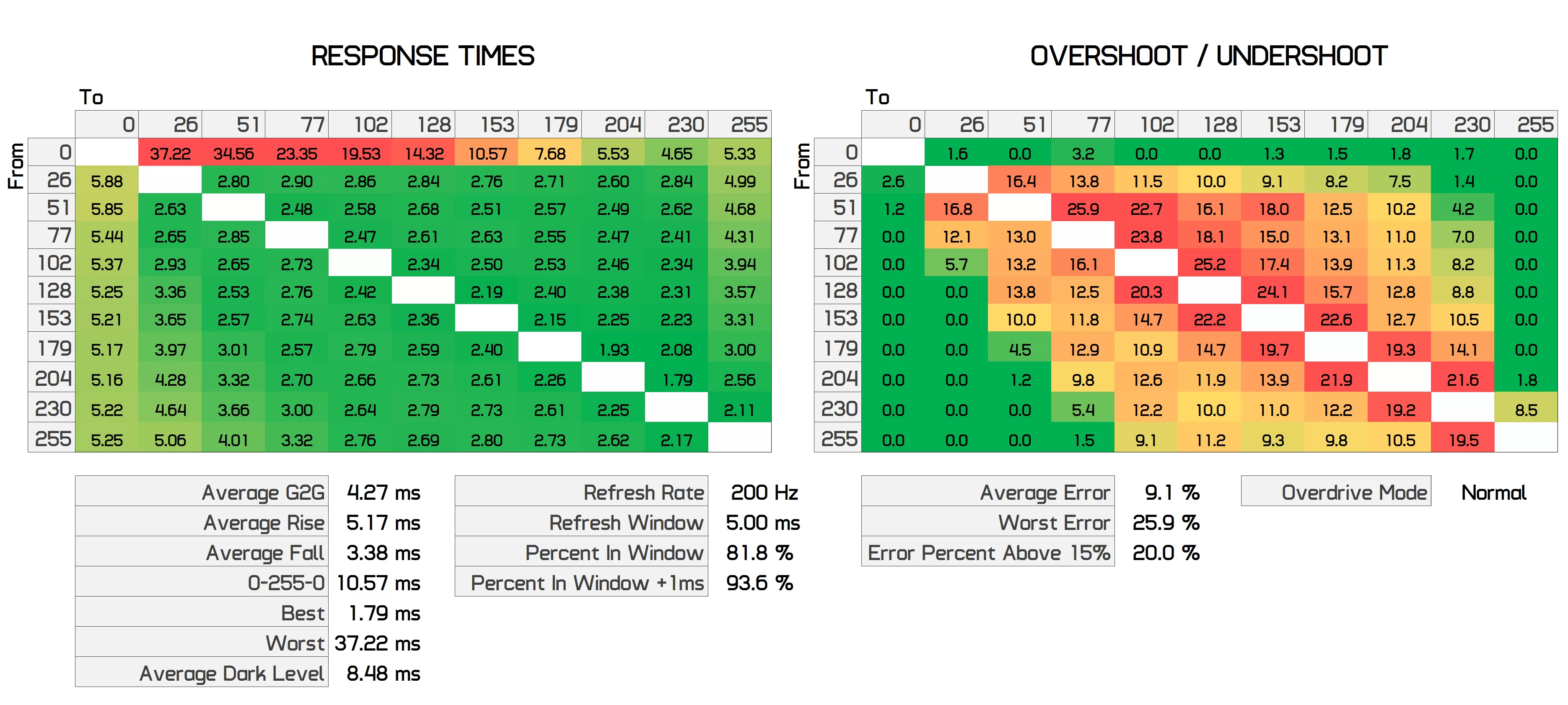
The overall grey to grey average is 4.27ms, very similar to the Asus PG35VQ, and this means that we are getting a true 200 Hz experience. However error rates are a piffling high for my liking, an average error of nine% and crucially, twenty% of transitions having an error rate higher up 15% says that you may notice inverse ghosting at times. Nosotros similar to encounter monitors accept fewer than fifteen% of transitions with errors above 15%, per my 15-15 rule, but the X35 is a fiddling to a higher place that here. Not the worst performance, not the best.


Unfortunately, there isn't a better mode than 'Normal' for 200Hz gaming. Farthermost takes the monitor to a 2.72ms grey to grey average and all merely eliminates dark level smearing, but introduces severe inverse ghosting. And on the opposite end of the scale, switching overdrive off leads to no errors, but a 12.26ms grey to greyness boilerplate with high levels of dark level smearing. Fifty-fifty though the X35 fails the fifteen-15 rule in the Normal mode, we feel it'due south the best balance of the three for gaming.
While nosotros haven't tested the PG35VQ nether our new test suite, the results for grey to grey average betwixt the X35 and PG35VQ are very similar in their optimal overdrive modes. This isn't a surprise as they both use the same console. But what you can see hither is the X35 performs well, particularly for a VA panel in terms of response times and refresh rate compliance. However over again you can see here that the error functioning is weak.


It's crucial to note that the monitor does perform differently with the FALD backlight enabled. With a dynamic backlight at play, we now take ii elements decision-making response: both the liquid crystals and the LED backlights. So nosotros get some pretty funky response time charts hither with numbers that are all over the place.
My recommendation when using the FALD backlight is to move from using the Normal to Extreme overdrive modes. The results here aren't amazing with some particularly slow transitions – information technology's hard to get the backlight and crystals to transition well in tandem – but this is the all-time residue between performance and error rate. Surprisingly, there is nearly no changed ghosting or dark level smearing when using Extreme + FALD, but that'south come at the expense of smearing in other areas.
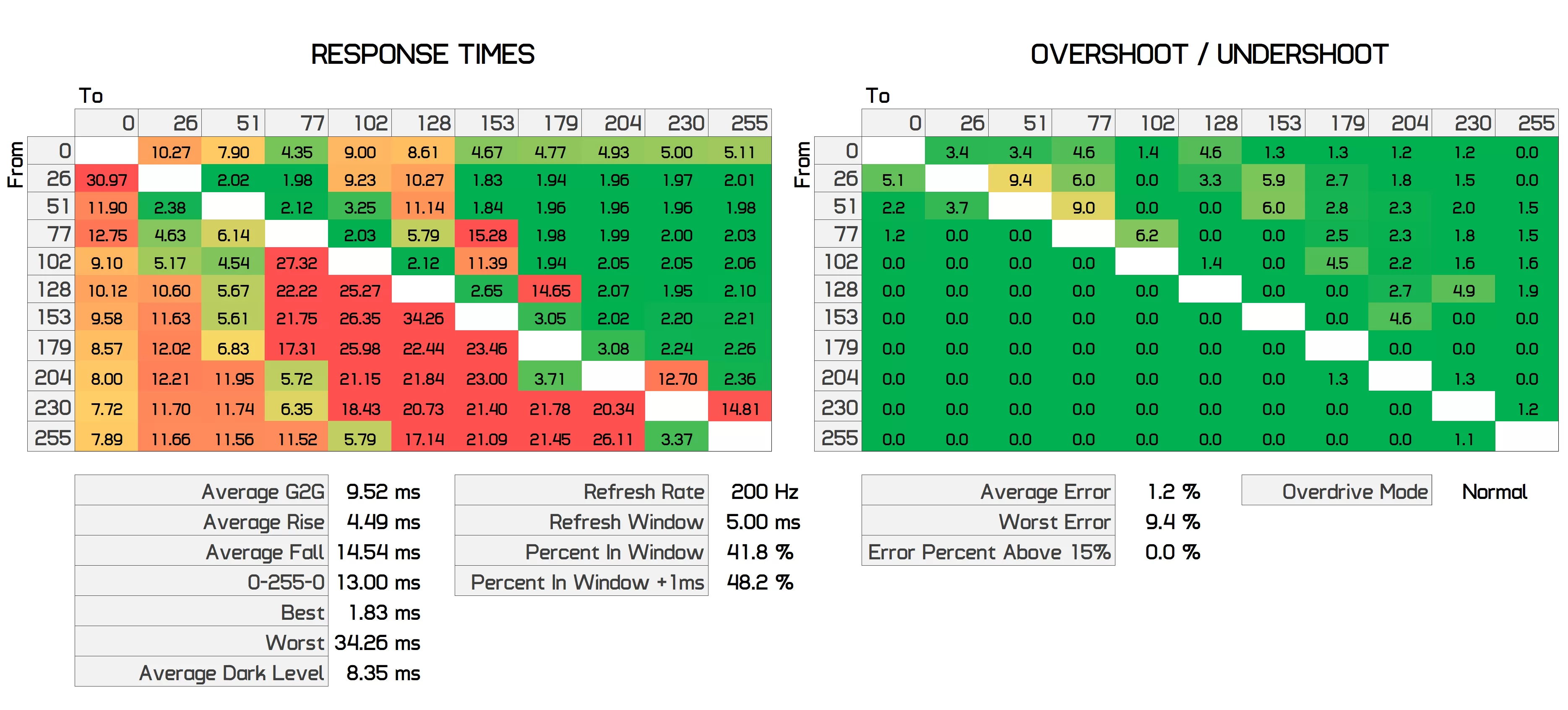
The Farthermost overdrive mode is too my recommendation for 60 Hz gaming. The grey to gray average here is college, at 6.30ms rather than iv.27ms like we saw using Normal at 200Hz, but it'due south still decent for 60 Hz.

Input latency is okay without blowing me abroad, eight.23ms is a bit faster than Acer'south previous X34 monitor, but still indicates around 5ms of processing lag, helped by the faster refresh rate. Interestingly, if y'all turn on the FALD backlight, input latency increases past around 4ms, presumably that'due south due to the additional processing that's needed to figure out what the FALD backlight should do.

Power consumption is also interesting. This monitor uses a lot more ability than other ultrawides of a similar size, even when displaying the same effulgence. The FALD backlight isn't a particularly efficient way of illuminating an LCD, consuming 20W more than non-FALD options.

One of the cardinal differences between the PG35VQ and Acer's Predator is their color performance. Asus has done a decent task of manufactory calibrating their offering, while Acer has kinda dropped the ball a scrap here with the X35. This is a flip of the situation with the 27-inch G-Sync Ultimate montiors, where we found the X27 was improve than the PG27UQ.
Default Colour Performance
Here we have greyscale performance. The CCT curve hurts performance, while it does follow the sRGB gamma curve well, a deltaE average of 3.16 is worse than the two.37 we get with the PG35VQ out of the box. Saturation functioning is also non as good as the PG35VQ, and that's down to a key difference in default configurations: Asus clamps their monitor to sRGB in the SDR style by default, while Acer leaves their monitor unclamped. And so Asus manages to hit a sub-two.0 deltaE in our ColorChecker tests out of the box, while Acer is above 2.0.


Even so default configurations are probably non what many users will really use. So for the Acer X35 nosotros'd recommend using the sRGB SDR style and tweaking a few other things (come across below). The X35 disables the FALD backlight by default in the SDR mode which we feel is the right motion to preclude haloing in desktop apps, while on the PG35VQ it'southward enabled by default.
Acer X35 optimal settings: Brightness (200 nits) 38, Relative Gamma: Default, Dynamic Backlight: Off, Contrast: 50, sRGB SDR: On, Color: R94, G100, B98, Overdrive: Normal. All other settings default.
Unfortunately these tweaks can't resolve the bug with the CCT curve, so greyscale performance is weak, especially compared to the PG35VQ which when tweaked hits a sub-1.0 deltaE average. But saturation performance is improved, at present with a deltaE average of 1.57, and ColorChecker is decent, falling just above a 2.0 deltaE average. It's not perfect, only information technology will do for gaming.
OSD Tweaked Color Operation


And so of course we tin perform a full calibration which resolves all the remaining issues, especially that CCT curve performance. You could even create multiple profiles, one for the monitor when sRGB clamped and another when non clamped, depending on your utilize instance.
Calibrated Colour Functioning


The Predator X35 is a wide gamut monitor, touting ninety% DCI-P3 coverage. Out of the box, we really get sub-2.0 deltaE averages when measuring against D65-P3, but because the monitor is left unclamped. Even so I wasn't able to amend performance through OSD tweaks, unlike with sRGB operation. Again, to get things upwardly to standard you'll need to perform a full calibration which works well.
For SDR mode effulgence, we get 480 nits when calibrated, correct at the elevation of the charts. This is artificially limited of grade, as the monitor can practise well above that in the HDR style as we'll see in a moment. Native contrast ratio is unimpressive at merely 2100:1; basically the same as the PG35VQ and not almost as high every bit some of the best VA panels we've tested. Luckily, we don't get much of a fall off when calibrated, so the default dissimilarity ratio isn't much higher than what we just showed.


Native uniformity is practiced, the fundamental zone is accurate relative to the heart while with the outer edges there is a slight vignette, which isn't unusual to run into from a curved VA console. Even so, functioning here is a bit weaker than the PG35VQ, at to the lowest degree when comparing our review units.

This is a fully HDR capable monitor, with DisplayHDR one thousand certification and a full assortment local dimming backlight with a decent zone count. All the stuff you see in this checklist is what you're paying $2,500 for, compared to lesser HDR monitors that are often several thousand dollars cheaper.

Brightness is excellent on this monitor. It achieves over 900 nits sustained in a full white window, which then increases to as high as 1100 nits for a 10% window with a slight autumn off for smaller windows. The sustained performance of this panel is marginally ameliorate than the PG35VQ, every bit is the wink brightness: the X35 is capable of a 1140 nit full screen white flash, which melts your eyes. This thing is seriously bright.

For multi-frame contrast, the Acer Predator X35 is at the limits of our testing tools, because the FALD backlight essentially turns off the entire backlight when displaying a fully black frame. It'southward also at the limits in our best instance unmarried-frame dissimilarity test, considering over again the local dimming backlight is very proficient at dimming night areas. This is where the FALD backlight has a significant advantage over semi-HDR edge-lit panels, such as the MSI PS341WU.


In our worst case test, which measures a bright zone right next to a nighttime zone, nosotros achieved effectually double the native contrast ratio. And so far, this is the best issue we've seen.

A lot of these corking results are brought about by the FALD backlight with its 512 zones, which does a decent chore of isolating bright areas and keeping dark areas really dark. This is how we get the spectacular HDR effect we're looking for. Nevertheless, it'southward not perfect: we're nonetheless talking about zones that encompass thousands of pixels, so there will be haloing in some situations. This is mitigated somewhat by the VA panel, and we didn't spot much changed haloing, only you'll definitely notice the backlight in action in desktop apps when, say, moving a bright mouse cursor over a nighttime area of an app.
The good news is that dissimilar with edge lit panels, you lot don't notice much haloing while gaming or playing back HDR video. The backlight is highly responsive and more often than not works actually well in these use cases.
Wrap Up
Beyond all the tests, the Acer Predator X35 performs similarly to the Asus ROG PG35VQ which was to be expected given the similar specs, same console and that both are aimed at the same crowd. In a lot of key areas, this means we're getting very good performance. The 3440 x 1440 panel is definitely 200 Hz capable with an average grey to grey response fourth dimension beneath 4.5ms, nighttime level smearing is better than average, and while overshoot could exist better controlled, the balance here is fine for gaming.
The Acer Predator X35 also delivers splendid HDR performance for gaming, thank you to its vivid backlight and 512-zone total array.

If you want an ultrawide monitor that delivers a proper HDR feel in today's games – and the HDR gaming ecosystem is better than ever these days – this is the kind of monitor yous want.
Nevertheless there were a few crucial aspects in which the Predator X35 falls a picayune behind the Asus PG35VQ. The active fan is louder and ramps its fan speed in an annoying mode. The manufactory color performance isn't as good. When you're spending $2,500 on a monitor, we'd really expect a skillful level of out of the box accuracy. The PG35VQ delivers this, while the Acer X35 doesn't, and when we're talking about two monitors that are so similar, that's what information technology ends up boiling down to.

Bottom line, if yous are tossing upward which monitor to spend on $2,500 all things being equal, our nod goes to the Asus ROG PG35VQ right now. The Acer model is even so pretty adept -- we're comparing it to the PG35VQ which is the summit gaming monitor out there -- but if y'all can get the Acer and not the Asus on your region, or the quondam is more affordable, then it's definitely worthy of your consideration.
Shopping Shortcuts:
- Acer Predator X35 on Amazon
- Asus ROG Swift PG35VQ on Amazon
- LG 34GK950F on Amazon
- Dell UltraSharp U4919DW on Dell.com, Amazon
- Acer Nitro XV273K 27" on Amazon, Newegg
- Asus ROG Swift PG27UQ on Amazon, Newegg
- Acer Predator X27 on Amazon, Newegg
- GeForce RTX 2080 on Amazon, Newegg
- GeForce RTX 2080 Ti on Amazon, Newegg

Source: https://www.techspot.com/review/1913-acer-predator-x35/
Posted by: hanksdisce1951.blogspot.com
0 Response to "Acer Predator X35 Review"
Post a Comment